The Spirit Enters
Stefan Jaracz Theatre in OlsztynDuration
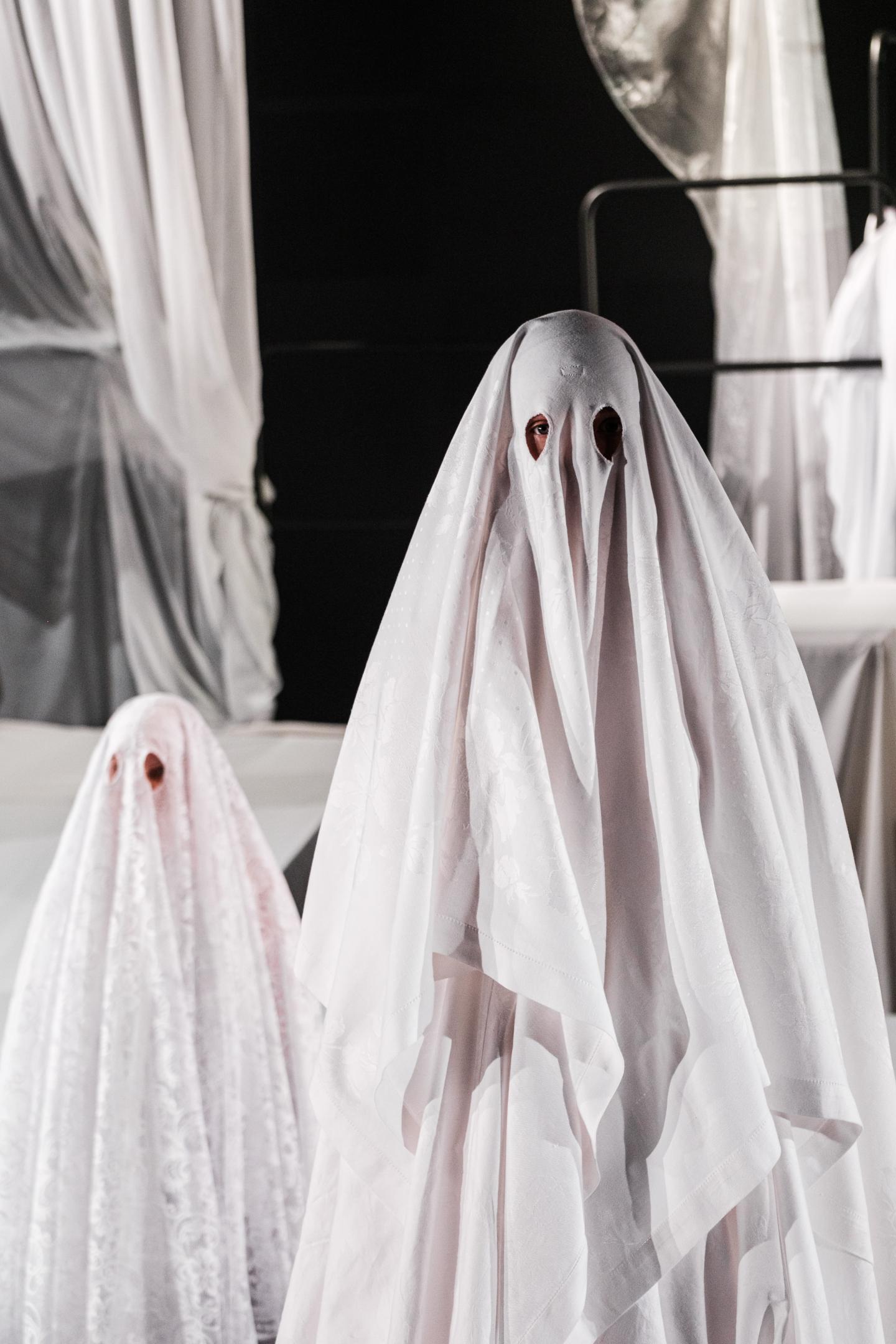
"The Spirit Enters" is an original production designed by director Weronika Szczawińska and playwright Piotr Wawer Jr., along with actresses and actors from the Olsztyn Theatre, which was created as a co-production of the Stefan Jaracz Theatre in Olsztyn and the Gdańsk Shakespeare Theatre. Inspired by the first act of "Hamlet" (in which the ghost of the titular hero's father appears twice), the creators explore questions about the legacy passed down from previous generations. Playing with Shakespeare's form of haunting, as well as contemporary references, they offer a personal and poetic, yet visually striking, on-stage conversation about the broadly defined "Father's Ghosts," figures of power, influence, and authority: Who are the ghosts we carry within us? What do they make us remember, what do they want, and what do they command? How do they haunt us, how do they take control of us—and how can we confront them? Weronika Szczawińska refers to her characters as "Hamlets"—figures with limited but developed subjectivity who ask questions: do they speak with their own voices, or are they inherited echoes of the past?
Performance for audiences aged 16 and up.
concept, script, dramaturgy: Weronika Szczawińska, Piotr Wawer Jr.
music: Aleksandra Gryka
direction: Weronika Szczawińska
lighting design: Monika Stolarska
set design, costumes: Marta Szypulska
stage manager: Magdalena Kunikowska-Zedlewska
A co-production of the Stefan Jaracz Theater in Olsztyn and the Gdańsk Shakespeare Theater.
cast:
Milena Gauer: Milena
Agnieszka Giza-Gradowska: Agnieszka
Marta Markowicz: Marta
Aleksandra Kolan: Aleksandra
Marcin Kiszluk: Marcin
Wojciech Rydzio: Wojciech
Piotr Wawer jr: Piotr (guest starring)
The perfmance is presented with subtitles both in English and Polish.
premiere: 30th of May 2025 r.
“The scenes with Hamlet’s father’s ghost are the direct inspiration for the performance. (…) The figure of the ghost of Hamlet’s father was treated both literally and metaphorically by director Weronika Szczawińska and co-author of the concept, script and dramaturgy, as well as actor Piotr Wawer Jr. The costumes and set design proposed by Marta Szypulska are a joke in themselves — ubiquitous white and grey drapes, curtains, tablecloths and sheets with holes cut out for the eyes are also the actors’ stage costumes (…).
The concept proposed by Weronika Szczawińska effectively lightens the weight of the story, as difficult topics and content are smuggled into the loose comedic form of the performance, allowing the creators to make a series of digressions and gags, bordering on the work of Shakespeare and pop culture. The actors are also supported by skilfully selected music (thanks to Aleksandra Gryka).
Thanks to the playful form (the visual and scenographic concept of the performance is a joke in itself) and the actors communicating in a casual language, not shying away from bawdy jokes (such as the one about the “bum” and the belt), and sometimes even profanity, The Spirit Enters is a rude comedy aimed at young people rather than adults. It will certainly be much easier for young people to identify with the form and content of the performance.”
Łukasz Rudziński, trojmiasto.pl
“What if, instead of the Danish king, a group of ghosts in sheets were placed on stage? The Spirit Enters, directed by Weronika Szczawińska, draws out what is not obvious in Hamlet. The platforms covered with white fabric resemble the scene of the Great Improvisation from Tadeusz Konwicki's Lava. At the same time, they are a playground with ladders, steps and tunnels. It makes you want to hang around there, play and explore.
Arousing the audience's desire to play is what makes this performance so successful. The creators use children's songs, rhymes and jokes to break down and defuse difficult, painful stories. Szczawińska takes a terrible, cruel and well-known story as her starting point. A story about revenge and the inability to carry it out. About powerlessness, betrayal and death. She chooses one episode from Shakespeare – the appearance of Hamlet's father's ghost – and uses this figure, a vision or a simple hallucination, to ask her own ‘to be or not to be’ question. (...)
Fathers are not only those who are legally obliged to care for their children. They are also people who mentor us in adult life. At work, school, theatre. We value their opinion or we must learn to value it. The Ghost Enters continues the conversation about violence in theatre. He looks at the figures of lecturers, directors and older colleagues – men in power who tell us how to live.
The final scene takes place in silence. The actors leave the stage. The performance should be over. Everyone is rushing to watch the evening news, kiss their children goodnight and go get some well-deserved rest. Piotr Wawer Jr. is the only one who has not seen his ghost. Agnieszka Giza, playing the role of a spirit, helps him complete his task, close the case, and settle the score. This is the first moment when we find ourselves so close to the actor and his real experiences. Previous stories may have been inspired by personal experiences, but it is only Piotr Wawer Jr. who confesses that he will talk about his father. Six years ago, at Komuna Warszawa, Piotr Wawer Sr. talked about his son and his mother in the autobiographical play Po prostu (Simply), which was also directed by Szczawińska."
Lidia Kępczyńska, Miesięcznik TEATR
"(...) In the play staged at the Jaracz Theatre in Olsztyn, everyone is a ghost in a way. We don't see their faces. It brings to mind David Lowery's 2017 film A Ghost Story, in which Casey Affleck appears almost entirely hidden under a sheet-like ghost costume. In the Olsztyn production, Milena Gauer, Agnieszka Giza-Gradowska, Marta Markowicz, Marcin Kiszluk, Wojciech Rydzio and Piotr Wawer Jr. also remain under white sheets throughout the entire performance.
However, while A Ghost Story was about mortality, melancholy and mourning, The Spirit Enters is primarily about family relationships. In The Spirit Enters, what is much more important than the fact that a ghost enters is that it is the ghost of the father who enters.
(...) The actors' silhouettes, covered with a white canvas, become like a screen — everyone can see their own problems with their father on it, hear echoes of their own life melody in the repeated refrains. Suspended somewhere between comedy and group therapy, The Spirit Enters consists of a series of games, challenges, accurate observations and blunt jokes.
(…) In Olsztyn, anonymous theatrical fathers step onto the stage: masters, directors and producers whom the actors have encountered on their journey. Memories of serious, masculine directing come to mind: “Come on, Marcinek, you have to help your buddy! But Piotruś, react to him! Look at yourselves! Be a man! But just between us guys! And the text, get on with the text!"
And again, a catalogue of aphorisms: from the witty ‘Don't say “I'm listening”, or I'll fuck you up’ to disappointment with the changes in the modern world: ‘Now you can't say anything to anyone.’
(...) In ‘Wchodzi duch’ (‘The Spirit Enters’), on the other hand, within an hour we move from an atmosphere of silliness to a lump in the throat, and from a sour social anecdote to the bitterness of a self-therapeutic confession and emotion."
Witold Mrozek, Gazeta Wyborcza
Festivals:
Festiwal Szekspirowski w Gdańskim Teatrze Szekspirowskim 02.08.2025r.